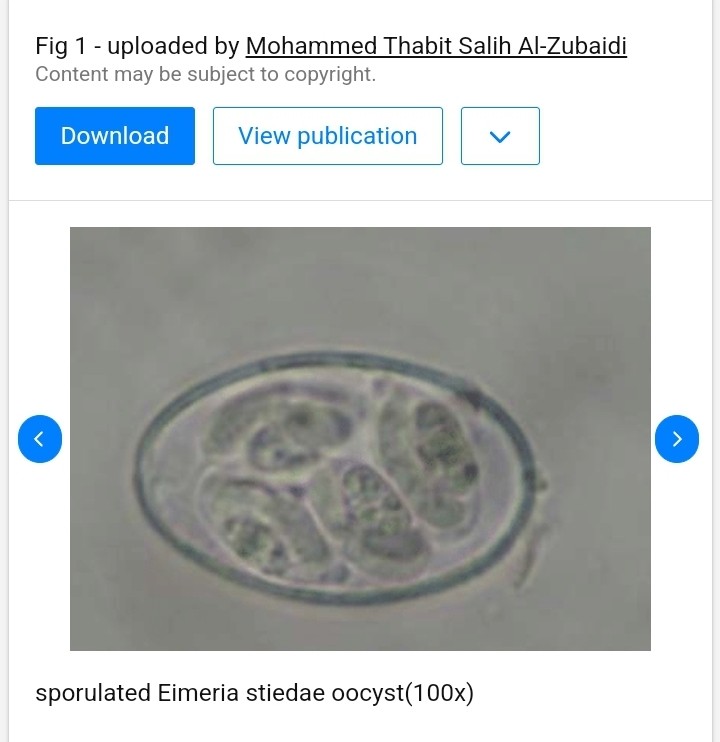

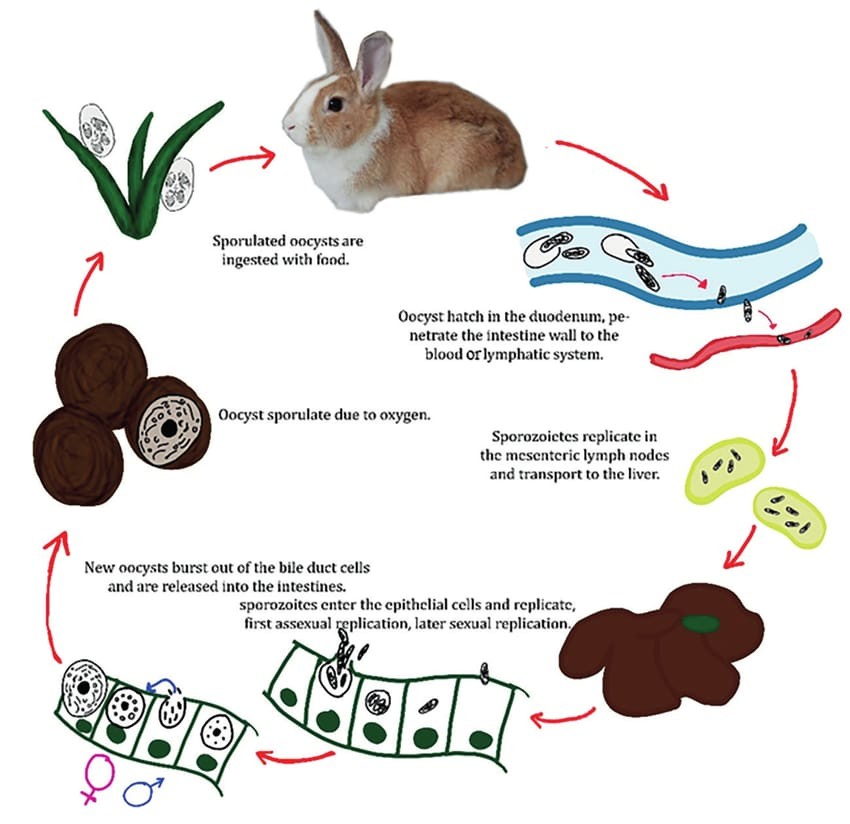
https://www.researchgate.net/figure/Lifecycle-of-Eimeria-stiedae_fig1_360584494
Eimeria in rabbits refers to coccidiosis, a common and contagious parasitic disease caused by Eimeria spp. protozoa that infect the intestine or liver of rabbits.
While some species cause no disease, others, like E. intestinalis (intestinal) and E. stiedae (hepatic), are highly pathogenic, particularly in young rabbits.
Symptoms include diarrhea, weight loss, poor growth, and lethargy, while E. stiedae can cause liver damage.
Diagnosis is confirmed by a veterinarian via fecal floatation, and treatment involves anti-parasitic medication and strict hygiene to prevent spread.
Symptoms of Rabbit Coccidiosis
Intestinal Coccidiosis
(from Eimeria species other than E. stiedae)
– Diarrhea (often with mucus or blood)
– Weight loss or poor weight gain
– Reduced appetite
– Scruffy or unkempt coat
– Lethargy
Eimeria stiedae can cause extra: (Hepatic Coccidiosis)
– Depression
– Anorexia (loss of appetite)
– Emaciation (extreme weight loss)
– Abdominal distention,
– Liver damage, which can be fatal
Causes and TransmissionGoogle say:
Coccidia is a Protozoa (Eimeria spp.).
Transmission is through the fecal oral route. Coccidia targets the intestines or liver. It is common in recently weaned kits, especially in crowded or unsanitary conditions.*
*This last statement is more applicable to meat breeders, not pet rabbits. Pet rabbits have a much wider infectious parameter, as they see vets (and car rides and anaesthesia is stressful) and they often get garden playtime. This is a very important factor, and many owners have been told by vets that their place is dirty, because of this single sentence in all the textbooks, not being updated into the new age of Domestic House rabbits as pets.
Coccidia can be acquired in one of many ways to domestic pet rabbits. Let’s look into these causes.
1) From the mom
Very often it is from the doe (the mom bun) in the phase where babies eat her cecotrophes to establish their gut health and stabilization. If mom has been bred often, a low immune system etc, the coccidia will have the eggs in her cecotrophs. When the babies get older and have an immune upset, esp anaesthesia, the coccidia, that has been held in check by the immune system, will then start multiplying and cause a break-out.
2) From the soil.
Any animal that has left oocyte-filled poop (thus eggs that can carry the coccidia) can transport it to other animals, especially feral cats that visit the garden at night. (Also a common way to get Toxoplasmosis).
Rabbits lick their feet and thus ingest the harmful little buggers when they clean up after a run. (This is a reason to keep your rabbits inside, or treat the safe area they play in).
3) From a bonded partner or playmate that carries it and shows no signs, as their immune system keeps it in check (remember, once this bun has an immune dip, it can also surface, just like with EC and Toxoplasmosis.
4) Unwashed greens
Those lovely greens, fresh apples etc you bought at the market? Wash them. Many times there is coccidiosis in the ground where the farmers work, and unwashed hands can transfer it easily to your greens. While you as a human have a much stronger system than your bunny, even you can get sick. Wash your food! Even if it looks washed.
5) Unwashed, Contaminated Hands. If you worked with a rabbit that has an active infection, even if not seen, and you have not washed and sterilized hands before going to a next rabbit, the oozites can be transferred to that rabbit, who licks his fur to wash and thus ingest them, leading to infection.
6) Unsterilized bedding from vets. A major concern when some vets take shortcuts, and though this is a lesser way, we know of a few cases that have originated like this – upon questioning, found that the bedding is just normally washed and not sterilized, unlike safety protocol and biosecurity state.
Coccidia can often lie dormant in the system for a long time, held in check by the immune system. When something happens that shocks the immune system, eg anaesthesia, other illness, stress etc and the immune system is compromised or has to focus elsewhere, coccidia can surge and be activated, or reactivated in some cases. This is much the same as with toxoplasmosis and EC (Encephalitazoon Cuniculi) that can also lie dormant in the system for long times, some even lifelong.
Treatment:
Baycox (Toltrazuril)
After many infected buns, we can state that the ONLY treatment that really got rid of it well, where it did not come back with the first vet visit, was one of the following 2 schedules:
- 3 days on, 5 days off, 3 days on, 14 days off, 2 days on; followed by 5 days of Panacur.for younger rabbits with intestinal infection,
- 5 days on Baycox, 5 days off Baycox but on Panacur, 3 days on Baycox, 14 days off everything, 2 days on Baycox, 5 days panacur for older rabbits or those with a worm infestation running together with it.
This schedule has been successfully tested with over 600 rabbits
Babies with initially untreated hepatic coccidiosis will always remain extremely small, though healthy gums, hair etc.
Weaning Enteritis:
This is not the Same Thing as Cocci.
It’s easy to confuse the two, both can cause diarrhea, weakness, and rapid decline in young rabbits. But they’re not interchangeable.
Weaning Enteritis is a
Bacterial overgrowth (often Clostridium spiroforme).
Dietary shift during weaning is the most common cause, though overcrowding or stress can trigger it. Weaning enteritis is common in kits 3-10 weeks old, especially upon starting pellets or on pellet heavy diets.
Symptoms:
* Mushy or watery diarrhea
* Bloating, hunched posture
* Sudden death within 24-72 hours
Diagnosis: Clinical signs + fecal testing
Treatment: Hydration, probiotics, fiber rich diet
Note: Prevention hinges on slow weaning, high fiber diet, and stress reduction
Treating coccidiosis with probiotics alone won’t work. Treating enteritis with toltrazuril won’t help. A fecal test is your best friend, it tells you what you’re fighting so you can treat it effectively.
Another similar looking illness is Giardia, of which South Africa has quite a lot esp in the Western Cape Area. It is VERY important to test for this too. Kryptosporidiosis has also been found in quite a number of rabbits, especially in Cape Town Durbanville Area.
Coccidia and Gut Health.
Gut Health Is Immune Health. Over 70% of the immune system is tied to the gut, while 30% is congenital.
Fiber First! Hay is the foundation of a rabbit’s diet, not enrichment, although it does act as a boredom breaker to keep chewing. Your Pellets should have at least 20% crude fiber, but most feed store brands fall short. Without hay most rabbits’ diets are lacking in fiber. Long strand fiber (hay) also keeps the gut moving and binds harmful bacteria. We will stay quiet for now on the intensely harmful foods that petshops sell… containing animal and fish proteins, so much sugars and harmful chemicals….
Low fiber causes enteritis, causing for example coccidia overgrowth, especially in kits and stressed mammy buns. If mom’s fiber is low, her milk and gut microbiome suffer. Kits inherit her gut health through grooming, cecotropes, and immune transfer. A fiber deficiency doesn’t protect her litter from enteritis or coccidia. Fur chewing is a common sign they’re lacking roughage. Soft stool and poopy butts, over production of cecotropes can indicate a diet that is too pellet heavy, or too much sugars, or too much greens (all showing too little hay/grass).
We do not have Benebac or Fiber-Plex in South Africa. We have asked the importers of Protexin many times to please get that too…
New strain of Eimeria in China:
https://www.sciencedirect.com/science/article/abs/pii/S1383576917301733